Work in four groups of four to create a shared Atlas of Spans: a broad collection of references exploring how things span, connect and support.
There are 16 students in the studio. Each student should contribute approximately 4–5 span examples, giving each group around 16–20 examples and the studio as a whole around 64–80 spans. Work holistically as a group: compare, connect and organise the examples rather than treating them as isolated individual submissions.
Each group should investigate a mixture of natural structures, physical and built structures, mathematical or computational structures, inhabited spans and experimental assemblies. A span can be found in a tree, root, shell, web, bridge, branching system, reciprocal structure, catenary, minimal surface or another system that connects point A to point B. Groups will not be assigned separate themes. Use the examples from our studio presentation as a starting point, then extend the collection through your own research.

Two-week Atlas sequence
The Atlas develops over two working weeks before the group pin-up:
- Week 1 – Thursday 24 September: studio introductions, launch of SPANS and the Atlas of Spans.
- Week 2 – Thursday 1 October: Grasshopper session and computational experimentation. Use the session to begin translating selected references into quick Rhino and/or Grasshopper studies.
- Week 3 – Thursday 8 October: physical wall pin-up and group presentation of the Atlas. Print the research and the process, not only polished end results.
Collect widely and look closely
Find a rich variety of examples across different scales, materials, locations and construction methods. Follow your curiosity and look for unexpected connections between references.
For each example, consider:
- What is being connected, and why? Who or what benefits?
- How does it carry loads and achieve stability?
- How do geometry, materials, components and joints work together?
- What processes or underlying rules generate its form?
- How is it assembled, maintained, adapted or disassembled?
- What might you learn from it for future experiments and architecture?
Use short annotations and your own diagrams to explain what interests you. Identify gaps in your understanding and questions you would like to investigate.
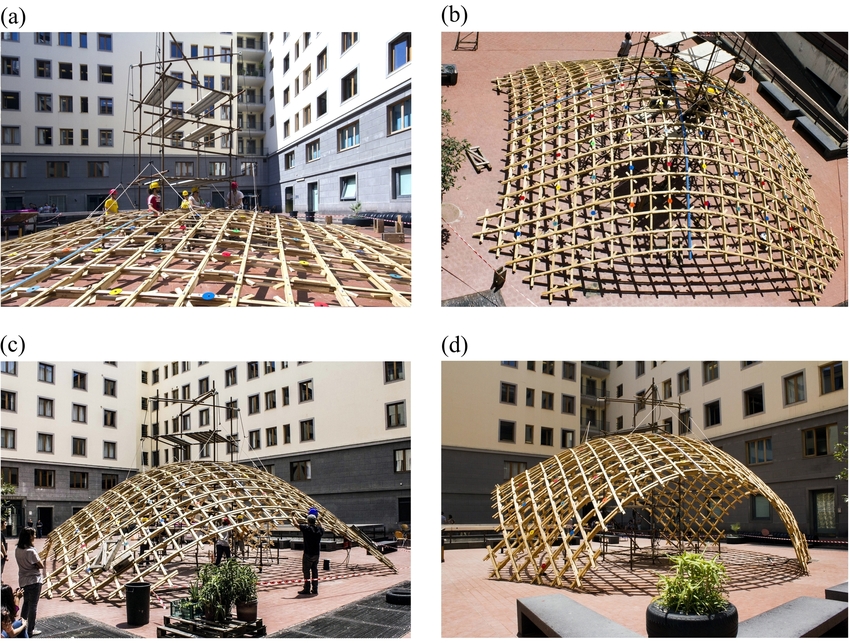
Develop selected spans through quick experiments
Do not stop at collecting references. For some of the spans that interest you most, make quick digital translations and variations:
- Rhino and/or Grasshopper screenshots showing how you are interpreting, abstracting or interrelating the span systems.
- Simple computational variations, combinations or rule-based studies rather than polished final models.
- Quick AI-assisted experiments using ChatGPT or another AI tool to reinterpret, combine, visualise or question the principles behind selected spans.
The purpose is to expose your thinking. Show prompts, iterations, failed directions, intermediate geometry and the choices that led from one experiment to the next where useful.
Create the shared booklet and wall pin-up
Use A4 landscape pages, with a consistent layout across the studio, suitable for both a research booklet and a wall pin-up.
Include:
- Clearly labelled images, with sources and credits.
- Name, location, date and designer, where applicable.
- Brief observations and annotated sketches explaining key features.
- Questions about the processes and principles behind each example.
- Rhino / Grasshopper process screenshots for selected studies.
- AI experiments and iterations where they help reveal an idea.
- Process as well as outcome: research trails, tests, comparisons, intermediate steps and unsuccessful experiments can all be valuable.
Organise your collection so that references can be compared. You might group them by structural behaviour, material, assembly process, geometry, force flow, how they are inhabited, or the type of connection they make. Draw explicit connections between natural and constructed systems, and between the examples developed by different people in the group.
Record each student’s contribution, but make the Atlas read as one connected group investigation.

Week 3: physical wall pin-up and group presentation
For Thursday 8 October, pin up the Atlas physically and present it as a group. We expect approximately 16–20 researched spans per group, supported by process material and quick experiments.
Be ready to explain:
- The range of span examples you discovered and why you selected them.
- Recurring structural, geometrical or organisational principles.
- Unexpected relationships between natural, mathematical, computational and built systems.
- How selected references were translated into Rhino / Grasshopper experiments.
- What you learned from the AI experiments and what changed between iterations.
- How the four individual investigations connect into one group Atlas.
- Which principles or systems you want to carry forward into the next physical and architectural experiments.
This is a research and process pin-up. We are interested in how the ideas developed, not only the most resolved images. Print enough of the intermediate work for the wall to communicate the trajectory of your thinking.
Leave a Reply