DS10 is 15 years old. This year we return to one of the studio’s core questions: how can a simple system become an ambitious piece of architecture through making, testing, computation and iteration?
15 YEARS · 2M VIEWS · 587K READERS · 561 PROJECTS / POSTS · 701 SUBSCRIBERS · 16 BUILT STRUCTURES · 48 GUEST CRITICS
- Google Slide Live Studio Presentation
- Current A4 Brief: full text below
- Video Presentation with Toby Burgess and Arthur Mamou-Mani
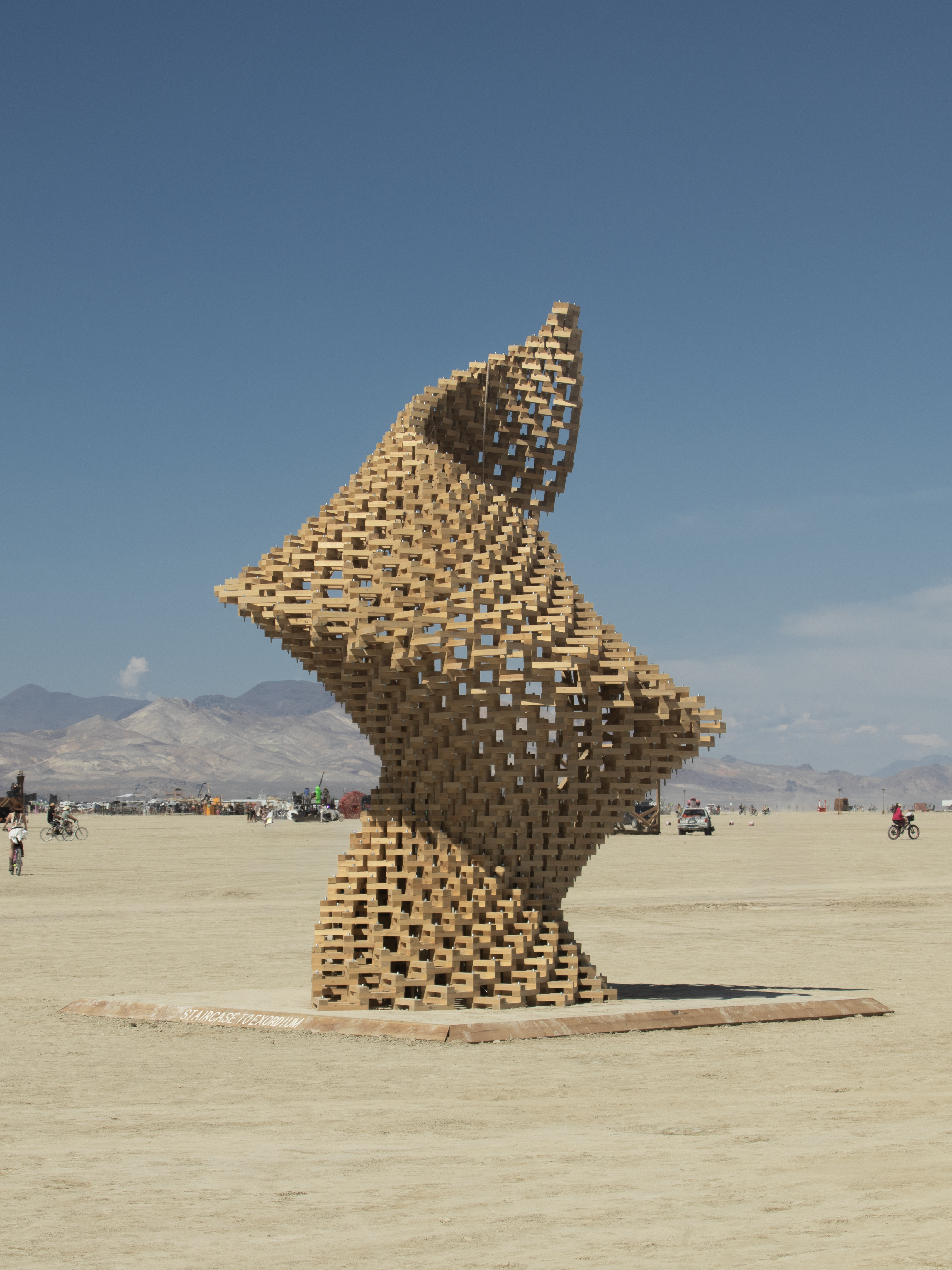
Studio Theme: SPANS
Tutors: Toby Burgess & Arthur Mamou-Mani
DS10 thinks like makers and acts like entrepreneurs. We design through systems rather than predetermined forms, combining computation, physical experimentation, structural logic, ecology, economics and architectural storytelling.
This year we investigate SPANS: structures and infrastructures that bridge disconnected places, programmes and communities. London and the Thames are a starting point; students may choose another site they can physically visit and justify through a connectivity study.
Students will design through constraints: material economy, structural performance, environmental impact and real-world cost.
Designing with AI
We will actively use AI tools throughout the design process, alongside Rhino, Grasshopper, simulation and physical making. Students will explore AI-assisted 3D modelling, coding and parametric workflows; map connections; generate and compare design alternatives; and develop drawings and visualisations from their own material and structural experiments.
Key prompts, code, iterations and design decisions will be documented. AI outputs must be checked against sources, geometric and technical reasoning, and physical tests. Students remain responsible for the work they develop.
Brief 01 — Spans and Systems
- 1.1 Atlas of Spans. As a group, compile an illustrated atlas of natural and constructed systems: trees, roots, shells, webs, branching structures, bridges, inhabited bridges and experimental assemblies.
- 1.2 Material and component studies: Two Systems, First Models. Individually compare two systems through material, component and joint experiments, and explain how they work and assemble. The October design review covers these first models and early studies towards 1.3. Materials remain open, including timber, polymers, masonry and 3D-printed systems.
- 1.3 Physical bridge and digital twin. Build a bridge spanning 1.5 m and supporting 5 kg at its centre. Develop a corresponding computational model using AI-assisted modelling and coding, Rhino, Grasshopper, simulation and optimisation. Predict behaviour, compare it with physical load tests, and revise the design. Develop the complete bridge through the 29 October fabrication checkpoint and 5 November assembly review, for final construction and documented testing on 12 November 2026, replacing the earlier 26 October target. Agree detailed test arrangements with the tutors.
- 1.4 Site and connection study. Begin early: map what needs connecting, who benefits and why a span is appropriate. Use AI-assisted network studies alongside sourced evidence and a physical site visit. Record the visit and start plans, sections and 3D studies in parallel with the experiments.
- 1.5 Budget and construction manual. Plan and record the complete bridge-model budget, with a maximum of £100. Produce a construction manual explaining components, quantities, joints and assembly, supported by photographs of the making process.
- 1.6 Design development record. Document weekly material and digital experiments, AI workflows, test results, failures and revisions. Show how lessons from the bridge and site studies inform the emerging architectural proposal.
Brief 02 — Inhabited Span
2.1 A researched position on 2045. At the end of Brief 01, readings and the future-scenario question will be introduced for the Christmas break, leading into Brief 02: What kind of civilisation are we designing for in 2045?
Nick Bostrom’s Superintelligence raises questions of control, alignment and power when machine intelligence exceeds human intelligence. Ray Kurzweil’s The Singularity Is Near / The Singularity Is Nearer proposes human-level machine intelligence around 2029 and a technological Singularity around 2045.
These are propositions, not facts. Investigate, challenge and take an informed position, including limited or uneven change. Consider work, wealth, mobility, education, construction, energy, ownership and social life. Show what your scenario changes in the programme, spaces, construction or operation of your architecture.
2.2 Programme and circular systems. Develop an inhabited bridge with complementary uses such as housing, culture, sport, mobility, ecology, energy or public space. Explain why they belong on the span and how they support one another. Link the programme to your AI position, site and connectivity study. Trace material origins, reuse and end-of-life, and identify regenerative or closed-loop synergies such as shared energy, water or resources.
Demonstrate structural plausibility, material efficiency, ecology, accessibility, circulation, assembly and long-term adaptability. Consider cost, fabrication, financing, ownership and maintenance. Continue using AI to develop and test the proposal, with decisions grounded in evidence.
2.3 Final deliverables.
- Plans, sections and elevations
- Structural studies and simulations
- Environmental analysis
- A well-photographed sectional and/or site model
- A 1:1 prototype of a node or part of the structural system
- A coherent booklet linking experiments, site, AI scenario, circular systems and architectural decisions

Tools, Making and Systems Thinking
- Rhino 3D as the core modelling platform
- Grasshopper for parametric systems and generative geometry
- Kangaroo for physics-based form finding and structural behaviour
- Ladybug / Honeybee for environmental analysis, energy and performance
- AI tools used critically for research, coding, analysis, scenario-building, modelling and visualisation
- Physical making, fabrication, load testing and 1:1 prototyping throughout the year
The objective is to design with AI and critically explore what architecture might mean because AI exists.
Leave a Reply